.png)
Resilience Isn’t Bouncing Back — It’s Building Forward: Adaptive Strategy for CEOs
- Erin Sedor

- Jul 21, 2025
- 8 min read
By Erin Sedor | Black Fox Strategy
Somewhere along the way, “resilience” became the business world’s favorite survival word. It showed up in boardrooms, annual reports, and keynote titles. It became shorthand for everything from crisis recovery to organizational grit to the general ability to “weather the storm.”
And almost everywhere I see it used, it means the same thing: the capacity to bounce back.
Snap back to normal. Return to baseline. Get through the disruption and resume operations as they were.
That’s not resilience. That’s recovery. And it’s a dangerously small ambition.
If your resilience strategy is designed to get you back to where you were, you’ve already lost ground. Because while you were busy recovering, everything around you kept moving. Your market shifted. Your competitors adapted. Your customers evolved. And your organization — having invested all its energy in returning to a prior state — is now further behind than when the disruption started.
Recovery is a necessary capability. But it is not a strategy. And the organizations that confuse the two are the ones most likely to find themselves facing the next disruption from an even weaker position than the last.
The Rubber Band Problem
The dominant resilience model in business today is essentially mechanical. Think of a rubber band: you stretch it, it snaps back. The assumption is that the organization has a “normal” state — a baseline of operations, revenue, capability — and that resilience means protecting or restoring that baseline after a shock.
This model made more sense in a slower world. When disruptions were less frequent and the intervals between them were long enough to actually return to something resembling the previous state, bouncing back was a viable goal.
That world is gone.
Today’s operating environment is defined by constant, overlapping change. Supply chain volatility, regulatory shifts, workforce transformation, AI acceleration, geopolitical instability — the disruptions don’t arrive one at a time and wait politely for you to recover. They compound. They interact. And they render your previous “normal” obsolete faster than you can rebuild it.
There's a reason for this, and it goes deeper than "the pace of change is accelerating." The rubber band model is built on seventeenth-century physics. Newtonian thinking — the kind that still dominates most strategic planning — assumes a predictable, controllable world where systems can be returned to their prior state after a disturbance. Push a pendulum, it swings back. Stretch a spring, it recoils. As Dr. Danah Zohar argues in her work on Quantum Management Theory, this mechanistic worldview is fundamentally exhausted. The reality your organization operates in is defined by uncertainty, interconnectivity, and constant motion. There is no stable state to return to. There never was — we just moved slowly enough that the illusion held. When your market, your workforce, your technology landscape, and your regulatory environment are all shifting simultaneously, "recovery to prior state" isn't just difficult. It's a design concept that no longer applies to living systems. And that's what your organization is — a living system, not a machine.
Organizations that treat risk management as separate from strategy have three times the failure rate during market disruptions, according to a multi-year organizational resilience study. That statistic isn’t about risk management — it’s about strategic design. When your approach to disruption is disconnected from your approach to direction, recovery is all you’ve got. And recovery alone can’t keep pace with a world that doesn’t slow down for you.
What Resilience Actually Requires
Real resilience isn’t about returning to a prior state. It’s about the organizational capacity to evolve through disruption — to use what happened as material for what comes next.
This is a fundamentally different orientation. Recovery asks: “How do we get back to where we were?” Resilience asks: “What did this reveal about where we need to go?”
That second question demands something most organizations aren’t built for: the ability to learn, adapt, and reorganize in real time. Not as a crisis response, but as an ongoing strategic discipline. The organization that thrives through disruption isn’t the one with the best disaster recovery plan. It’s the one that was already building toward what’s next — before the disruption forced the question.
Most organizations don’t fail because they can’t recover from a single shock. They fail because they recover to a position that’s already been made irrelevant. They rebuild the bridge to a shore that’s shifted. The disruption wasn’t the fatal blow — the failure to evolve through it was.
This is what I mean when I talk about Evolution as a strategic imperative. In the Essential Strategy Formula, Evolution isn’t a future concern, or a planning-cycle afterthought. It’s the active, continuous discipline of anticipating the changing needs of everyone who serves and is served by the organization — employees, customers, partners, communities — and building the internal capacity to meet those needs before external forces demand it.
When Evolution is embedded in your strategy, disruption doesn’t hit a static target. It meets a system that’s already in motion. Already adapting. Already oriented toward what’s coming rather than anchored to what was.
Beyond Resilience: The Case for Building Forward
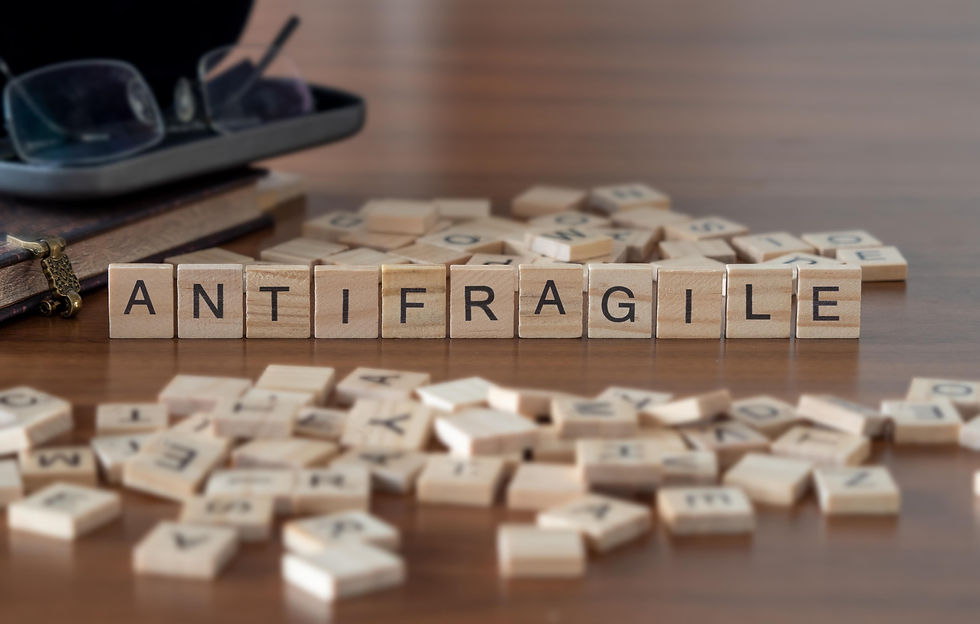
I love Nassim Nicholas Taleb’s concept in Antifragile about how antifragile systems actually grow stronger from disorder. Most resilience planning aims for robust — the ability to endure a hit and stay intact. That’s better than fragile, but it’s not enough. The aspiration should be antifragile: an organization that doesn’t just survive disruption but uses it as a catalyst for becoming something better than what existed before.
Taking it from another angle, ecologist C.S. Holling spent decades studying how natural systems respond to disturbance, and what he found should change the way every CEO thinks about resilience. Holling drew a distinction between what he called engineering resilience and ecological resilience. Engineering resilience measures how fast a system returns to equilibrium after a shock — the rubber band. Ecological resilience measures something fundamentally different: the capacity of a system to absorb disturbance and reorganize while retaining its essential function and identity. Not snapping back. Transforming through.
Holling's research showed that living systems move through a natural adaptive cycle — growth, maturation, release, and reorganization. The release phase isn't a failure. It's where the system restructures for its next evolution. Organizations that fight to skip it don't become more resilient. They become more brittle.
This isn’t aspirational language for a motivational poster. It’s a design question. And it has practical answers.
Most strategic planning actually makes organizations more fragile — not less. By codifying a fixed set of assumptions into a static plan, organizations create rigidity. They invest in a single predicted future and build infrastructure around it. When reality deviates — and it always does — the plan becomes dead weight. The organization has to fight its own strategy in order to adapt. That’s not resilience. That’s a structural liability disguised as discipline.
An antifragile organization requires three things your rubber-band resilience model doesn’t provide.
First, it requires a Purpose that acts as a compass, not a destination. When everything around you shifts, the organizations that adapt fastest are the ones whose people know why they exist — not just what they do. Purpose that is internally compelling gives people a reason to navigate toward something rather than scramble back toward something else. It turns disruption from a threat to be managed into a signal to be read.
Second, it requires Growth that is matched by internal capacity. External growth without internal development — without expanding the capabilities, culture, and learning systems that sustain it — creates fragility. You end up with an organization that looks impressive from the outside and fractures under pressure from the inside. Real Growth builds depth alongside reach. It’s intentional expansion, not accumulation.
Third, it requires Equilibrium as an active mechanism, not a passive hope. Purpose, Growth, and Evolution don’t maintain themselves in balance. They require constant, conscious recalibration — the strategic discipline of sensing when one dimension is pulling too far ahead or being neglected, and adjusting before the imbalance becomes a crisis. Equilibrium is what keeps the system adaptive instead of reactive. It’s the difference between a strategic response and an organizational panic.
Why Most Resilience Strategies Miss the Point
Here’s what I see over and over in the organizations I work with: resilience planning that sits in a silo. It’s a risk management exercise, a business continuity document, or a crisis communications playbook. It lives in a binder (or more commonly, a SharePoint folder nobody opens), completely disconnected from the organization’s strategic direction.
That disconnect is the vulnerability. Not the disruption itself.
When your resilience thinking is separated from your strategic thinking, you can only react. You can’t anticipate, because your resilience framework doesn’t know where the organization is headed. You can’t evolve through disruption, because your strategy doesn’t account for the possibility that disruption will change the trajectory. And you can’t build forward, because your recovery plan was designed to return you to a state that may no longer be relevant.
This is precisely why I build risk appetite into the strategic planning process from the start — not as a compliance layer added afterward. When an organization defines how much it’s willing to invest, how fast it’s willing to move, how far it’s willing to change, and what threats could disrupt its mission critical path, those decisions aren’t risk decisions. They’re strategy decisions. And they’re the decisions that determine whether your organization bends or breaks when the pressure arrives.
Organizations Move in Seasons
There’s a reason the natural world doesn’t try to stay in summer. Markets cycle. Industries evolve. Organizations move through seasons of expansion and consolidation, innovation and optimization, growth and integration. Fighting those rhythms exhausts resources. Working with them creates sustainability.
Resilience — the real kind — requires leaders who can sense what season they’re in. Not just economically, but organizationally. Are you in an expansion phase that demands bold moves and risk tolerance? Or are you in a consolidation phase that calls for integration, system-building, and the internal depth that will support the next expansion?
Pushing for aggressive growth when your organization needs integration creates chaos. Holding back when the window is open creates stagnation. The organizations that build forward are the ones led by people who can read the rhythm and design strategy that moves with it — not against it.
This is a capacity most leadership development programs don’t even address. And it’s one of the most consequential capabilities a CEO can develop. Because the rhythm doesn’t announce itself on a dashboard. It’s felt in the energy of the organization, the pace of decision-making, the quality of internal communication, and the degree to which your people are thriving or surviving. Leaders who sense these things navigate disruption differently than those who only see the financials.
What This Means for You
If you’re leading an organization right now, stop asking whether your team can survive the next disruption. That’s the wrong question. It sets a ceiling where there should be a launching pad. Adaptive strategies for CEOs require a more honest and expansive dialogue.
Ask these questions instead.
Are we building an organization that grows stronger through challenge?
Is our strategy designed to evolve, or only to endure?
When the next disruption arrives — and it will — will it hit a system that’s already adapting, or one that’s still recovering from the last one?
Your answer lives in your strategic design. Not in a resilience plan, not in a crisis playbook, and not in the hope that things will settle down long enough for you to catch your breath. The organizations in the top ten percent — the ones that consistently execute their strategies while the other ninety percent stall out — aren’t better at surviving disruption. They’re better at designing strategy that accounts for it from the start.
Resilience isn’t bouncing back. It’s building forward. And that starts with strategy built for the world you’re actually operating in — not the one you’re trying to get back to.
Erin Sedor is an executive advisor and strategic performance expert with 30+ years helping organizations build strategy that actually works. She is the creator of Essential Strategy and the Quantum Intelligence framework for conscious, adaptive leadership.


Comments